
Amazon Marketing Cloud Prime Day Strategy for 2025
Plan your amazon marketing cloud prime day strategy with full-funnel insights, advanced audience targeting, and ROI-driven campaign design.
 Adriana Blazquez 14 min read
Table of contents
The competition around Amazon Marketing Cloud Prime Day campaigns has intensified year after year, making it one of the most critical and performance-driven moments for brands selling on Amazon. In 2024, brands saw a 2.8x increase in impressions and a 2.6x rise in sales compared to the daily July average. This surge in demand is a massive opportunity — but only for those equipped with the right data infrastructure to act fast and smart.
That’s where Amazon Marketing Cloud (AMC) becomes essential. More than a reporting tool, AMC empowers brands with event-level data, full-funnel analysis, and multi-touch attribution, helping them decode what truly drives performance before, during, and after Prime Day. As competition peaks in 2025, having a solid Amazon Marketing Cloud Prime Day strategy will define which brands capture market share and which ones fall behind. This guide delivers the advanced insights you need to turn AMC into your Prime Day advantage.
Why Amazon Marketing Cloud Prime Day strategy matters in 2025
Key performance shifts seen during Prime Day 2024
Prime Day 2024 confirmed what many advertisers already suspected: the scale and intensity of this sales event have outgrown traditional tactics.
According to aggregated campaign data:
-
Impressions surged by 2.8x
-
Total sales rose by 2.6x compared to average July days
-
Sponsored Ads impressions increased by 187%
-
Sponsored Ads sales increased by 141%, despite stable ROAS
-
Brands offering deals saw 3.1x higher sales
-
Brands without deals still achieved a 48% lift
-
Combined Sponsored Ads and DSP strategy delivered:
-
2.6x higher purchase rates
-
3.6x more sales
-
2.7x greater ROAS
-
These spikes reflect not just consumer demand, but a steep escalation in advertising competition. These results expose a key reality: Prime Day is no longer about visibility alone—it’s about integrated, data-informed orchestration.
Why brands need data-driven precision, not guesswork
In such a competitive arena, relying on standard reports and assumptions simply doesn’t scale. To capitalize fully on Prime Day’s potential, brands need actionable insights on how their ads perform across the entire conversion funnel—from awareness to purchase. This is where a robust Amazon Marketing Cloud Prime Day strategy becomes essential.
Amazon Marketing Cloud (AMC) offers brands access to event-level data, cross-channel analysis, and the power to answer questions no other Amazon Ads tool can. It lets you track how a customer engages with a DSP video, visits a product detail page (PDP), and later converts through a Sponsored Product ad—insights critical to optimizing spend and identifying what truly drives performance.
In 2025, the brands that will thrive on Prime Day are those that approach it not as a flash sale, but as a complex, data-intensive marketing operation. With AMC, marketers can break down silos, pinpoint high-value segments, and build precision strategies that are calibrated to maximize every advertising dollar.
Understanding Amazon Marketing Cloud for Prime Day success
How AMC goes beyond standard Amazon Ads reports
Amazon Marketing Cloud (AMC) is not a reporting dashboard. It’s a secure data clean room that processes event-level signals across Amazon’s ad ecosystem. Unlike aggregated reports, AMC enables custom SQL queries, unlocking granular insights on user behavior, cross-channel paths, and conversion timing.
While Sponsored Ads and Amazon DSP offer prebuilt metrics, they operate in silos. AMC merges data across both, plus your first-party sources, giving a holistic view of what drives performance.
This matters during Amazon Marketing Cloud Prime Day strategies, where consumer journeys are chaotic. AMC exposes the real impact of upper-funnel ads that standard models ignore. For Prime Day, this means knowing what touchpoints lead to actual sales, not just clicks.
Core features that make AMC critical during Prime Day
-
Full-funnel visibility: Track users from awareness to purchase, linking DSP, Sponsored Products, and even Streaming TV exposures.
-
Multi-touch attribution: Move beyond last-click models. See how early ad interactions affect downstream conversions.
-
Custom audience creation: Build and activate segments like NTB shoppers, cart abandoners, or PDP viewers—all based on behavior.
-
Conversion timelines: Use AMC’s timeline queries to know when users convert post-exposure. Ideal for optimizing lead-in vs. event vs. lead-out phases.
-
First-party data integration: Upload hashed customer data to enrich targeting and build lookalike audiences across Amazon’s channels.
Unlocking full-funnel visibility with AMC during Prime Day
Mapping the complete shopper journey across channels
One of the biggest challenges in Prime Day campaigns is understanding how users move through the funnel. AMC solves this by capturing event-level data from every ad interaction—impressions, clicks, PDP views, and conversions—across Amazon DSP, Sponsored Ads, and Streaming TV.
A user might first see a DSP display ad, later click a Sponsored Brand, and finally convert via a Sponsored Product. Standard reports miss this. AMC maps the full path, exposing which touchpoints truly drive action.
For an effective Amazon Marketing Cloud Prime Day strategy, this means identifying which ads influence consideration vs. conversion. It also allows you to design campaigns that sequence messages across the funnel rather than relying on isolated tactics.
Using AMC for accurate multi-touch attribution
AMC removes the bias of last-touch attribution. With multi-touch analysis, brands can measure how early interactions—like a DSP view or brand search—contribute to conversions days later.
This is critical during Prime Day, where multiple channels interact at high velocity. AMC lets you:
-
Assign partial credit to each ad exposure in a conversion path
-
Identify which combinations of ad types convert best
-
Evaluate the true value of upper-funnel campaigns (e.g., video or category-level targeting)
Building strategic audiences in AMC for Prime Day
Targeting NTB, PDP viewers, cart abandoners, and LAA
AMC allows brands to build custom audiences based on actual user behavior—not just pre-defined segments. During Prime Day, this level of control is essential to drive efficient retargeting and acquisition.
Key audience types within your Amazon Marketing Cloud Prime Day strategy:
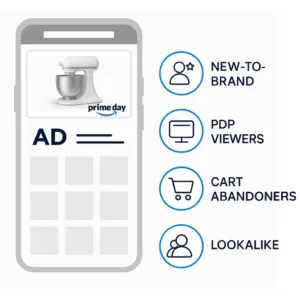
New-to-Brand (NTB): Identify users who convert for the first time with your brand. AMC can pinpoint which products act as acquisition drivers, allowing you to prioritize them in lead-in campaigns.
PDP viewers: These are high-intent visitors who viewed product detail pages but didn’t purchase. AMC lets you group them by category, product type, or interaction level for precision retargeting.
Cart abandoners: AMC detects users who added items to cart and dropped off. These segments typically have the highest conversion probability when retargeted with urgency messaging.
Lookalike Audiences (LAA): Build audiences similar to your top customers using first-party data. AMC models behavior patterns, not just demographics, ensuring better alignment.
Real use cases powered by AMC audience segmentation
— Example — A consumer electronics brand used AMC to identify PDP viewers who had interacted with video ads during Lead-In. They created a layered retargeting campaign for Prime Day, offering limited-time bundles to this group. The result: 2.3x higher conversion rate and 41% lower CPC compared to general retargeting audiences.
— Example — A beauty brand built NTB cohorts from Prime Day 2023 using AMC. These segments were re-engaged in 2024 with custom creatives. The audience converted at a 58% higher rate and generated a 32% higher LTV over six months.
Audience segmentation in AMC isn’t just granular—it’s actionable. For Prime Day, it becomes the backbone of high-ROI targeting across all funnel stages.
Path to purchase analysis with AMC in Prime Day campaigns
Timeline queries and funnel-stage mapping
Amazon Marketing Cloud enables precise measurement of conversion delays using timeline queries. This allows brands to map how long it takes shoppers to move from first ad exposure to final purchase—critical insight during a high-pressure window like Prime Day.
With AMC, you can:
-
Analyze average time to convert by channel (DSP vs. Sponsored Ads)
-
Identify bottlenecks in the funnel
-
Understand which campaigns influence consideration vs. purchase
These data points help calibrate media investment by funnel stage and improve the pacing of campaigns.
Aligning campaign duration to real customer behavior
Timing is everything in Prime Day. AMC reveals whether your audience converts in 2 hours or after 10 days, and which ad types initiate that path. Matching your lead-in and retargeting windows to actual shopper behavior avoids wasted spend.
— Example — A lifestyle brand discovered that most NTB users needed 7–10 days post-DSP exposure to convert, but only 1–2 days after viewing a Sponsored Product. They extended awareness campaigns and focused last-minute Sponsored Ads for conversions—doubling NTB acquisition efficiency.
However, ad timing is only part of the equation. For users who revisit PDPs days later, listing content becomes the conversion lever. Tools like Epinium help ensure those PDPs are not just visible but highly optimized—with keyword-rich titles, compelling bullet points, and A+ visuals that align with buyer intent.
By integrating SEO-optimized content with AMC-based targeting, brands close the loop between traffic generation and conversion, maximizing results throughout the path to purchase.
For brands looking to stay ahead with integrated ad and content strategies, Epinium’s newsletter offers regular insights on how to align Amazon Marketing Cloud data with SEO-driven content optimization. From Prime Day tactics to long-term growth planning, it’s a resource built for marketers who want to turn analytics into real competitive advantage.
Advanced metrics in Amazon Marketing Cloud Prime Day
Lifetime Value (LTV), New-to-Brand cost and incremental sales
Standard metrics like ROAS don’t capture the full picture. During Prime Day, brands need to assess not just how much they sell, but what kind of customer they acquire and what long-term value those users represent.
With Amazon Marketing Cloud, it’s possible to:
-
Calculate Lifetime Value (LTV) by tracking post-Prime Day purchases
-
Measure Cost per New-to-Brand (CNTB) to evaluate acquisition efficiency
-
Analyze incrementality—separating real ad impact from organic sales
These metrics show whether aggressive bidding during Prime Day is sustainable or simply costly. A high ACoS may be acceptable if NTB users deliver strong LTV over 6–12 months.
Using AMC to redefine how you calculate ROI
ROI in amazon marketing cloud prime day strategy is not linear. AMC helps answer questions like:
-
Which campaigns drive repeat buyers, not just one-time sales?
-
Are my NTB customers more valuable than returning ones?
-
How many conversions would happen without ads?
This is especially useful post-event, where AMC can compare exposed vs. control cohorts or run baseline lift studies.
But capturing the full ROI requires more than advertising data. If users return to a product page weeks after their first exposure, the quality of your content becomes critical. That’s where solutions like Epinium complement AMC: ensuring your listings convert by being relevant, well-structured, and aligned with user search behavior.
Together, AMC and Epinium create a framework for holistic ROI analysis—tracking the ad journey and optimizing the destination.
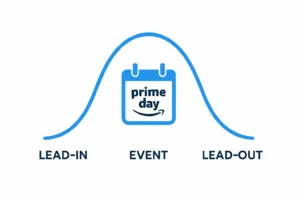
The three-phase Amazon Marketing Cloud Prime Day strategy
Lead-In
The weeks leading up to Prime Day are critical. AMC enables you to:
-
Identify high-intent segments based on past Prime Day behavior
-
Build audiences like PDP viewers, cart abandoners, and NTB prospects
-
Generate Lookalike Audiences (LAA) using CRM data and purchase patterns
Use Purchase Timeline queries in AMC to define how long your average customer takes to convert. This informs how early to launch campaigns and how to pace budget.
Parallel to audience building, it’s essential to optimize product content. Prime Day traffic is high-volume, but it won’t convert without quality PDPs. This is where Epinium supports your lead-in phase—improving SEO structure, keyword indexing, and visuals. Better content means better conversion when retargeted users return to buy.
Event
During Prime Day, AMC helps monitor:
-
Which audiences are converting (exposed to DSP, retargeted via Sponsored Display)
-
Which SKUs are driving NTB acquisition vs. repeat purchases
-
How to balance budget and frequency across channels without overspending
Overlay AMC audiences into your Sponsored Ads strategy: bid higher for those exposed to DSP or who abandoned carts recently. AMC insights allow for cross-channel prioritization, ensuring media spend follows actual user behavior, not assumptions.
Even with AMC’s latency (24–72h), early-day performance data informs adjustments for multi-day events. Combine that with sales dashboards and pre-built audiences for real-time campaign agility.
Lead-Out
Post-Prime Day is not a cooldown—it’s a monetization window. AMC allows:
-
Retargeting of non-converting visitors from the event
-
Activation of NTB cohorts for second-purchase campaigns
-
Analysis of LTV trajectories by cohort and campaign
Epinium plays a complementary role here too. With increased post-event traffic, optimizing listings ensures retargeted traffic converts efficiently, particularly for upsell and cross-sell tactics.
Use AMC’s Tentpole Analysis to evaluate performance across Lead-In, Event, and Lead-Out. This full-cycle view is what turns your amazon marketing cloud prime day strategy into a repeatable, data-driven growth engine.
How AMC adapts your Prime Day strategy to a four-day event
A four-day Prime Day changes the dynamics. Urgency spreads out, and campaigns must adapt in both timing and messaging.
With Amazon Marketing Cloud, you can:
-
Analyze hour-by-hour performance by channel and audience
-
Adjust pacing strategies to avoid early budget burn
-
Track ad frequency and detect audience fatigue
AMC insights allow brands to map which segments convert early vs. late. Use this data to stage your creative narrative:
-
Day 1: broad awareness and deal discovery
-
Days 2–3: targeted retargeting and urgency buildup
-
Day 4: “last chance” messaging to drive indecisive buyers
Frequency control is essential here. AMC enables tracking of exposure per user, preventing waste from oversaturation and supporting message variation.
Audience expansion and LTV insights by purchase window
More event days mean more touchpoints and larger retargeting pools. AMC helps:
-
Segment buyers by day of purchase
-
Compare performance of early vs. late converters
-
Identify which cohorts show higher LTV over time
This extended window also benefits content. With users engaging over multiple days, well-optimized listings play a bigger role. Tools like Epinium ensure PDPs stay relevant and competitive, helping to convert mid-funnel users returning after multiple ad touches.
Prime Day AMC checklist for brands and agencies
Technical preparation and campaign design
A winning amazon marketing cloud prime day strategy starts weeks in advance. Use this checklist to ensure every element is aligned:
Pre-Lead-In (4–6 weeks before Prime Day)
-
Define KPIs: NTB growth, ROAS targets, LTV/CNTB ratios
-
Set up AMC data sources (DSP, Sponsored Ads, 1P data)
-
Upload CRM/email lists (hashed) for audience building
-
Run Purchase Timeline Queries to model conversion delays
-
Use AMC to identify high-performing SKUs from past Prime Days
-
Optimize product pages with tools like Epinium to improve indexing, ranking and conversion
Lead-In (2–4 weeks before)
-
Launch awareness and ranking campaigns
-
Create predictive audiences: PDP viewers, cart abandoners, NTB
-
Deploy lookalikes from AMC segments
-
Adjust content based on keyword gaps and PDP insights
-
Sync AMC and Epinium data to align traffic and PDP performance
Event (Prime Day live)
-
Monitor AMC exposure data (24–72h lag)
-
Bid higher on retargeting segments from AMC
-
Cross-check sales data with AMC audience overlaps
-
Use A/B testing for headline messages and Sponsored creatives
Lead-Out (2–3 weeks after)
-
Retarget non-converters and low-frequency exposed users
-
Track LTV for Prime Day NTB buyers over time
-
Run Tentpole Analysis: Lead-In vs. Event vs. Lead-Out impact
-
Use Epinium to refresh listings for Q4 events (Black Friday, Cyber Monday)
Post-event analysis for Q4 and beyond
AMC doesn’t end with Prime Day. Use it to:
-
Identify long-term value by cohort
-
Refine audience models for Black Friday and Cyber Monday
-
Detect which ad paths generate true incremental growth
-
Reinvest in content improvements that lifted ROAS
The brands that win Prime Day are the ones that treat it as a strategic test bed. AMC gives the data; Epinium helps make every PDP ready for conversion. Together, they define your blueprint for the next sales peak.
FAQ: Amazon Marketing Cloud Prime Day strategy
What is Amazon Marketing Cloud and how is it different from standard Amazon Ads reports?
Amazon Marketing Cloud (AMC) is a secure data clean room that processes event-level signals across Amazon’s ad ecosystem, rather than a reporting dashboard. It enables custom SQL queries on user behavior, cross-channel paths, and conversion timing, merging data from Sponsored Ads, Amazon DSP, and first-party sources into one holistic view that prebuilt metrics from either channel alone can’t provide.
How much did Prime Day 2024 campaigns grow compared to a typical July day?
Aggregated campaign data showed impressions surged 2.8x and total sales rose 2.6x versus the daily July average. Sponsored Ads impressions increased 187% and sales increased 141% with stable ROAS, while brands combining Sponsored Ads and DSP saw 2.6x higher purchase rates, 3.6x more sales, and 2.7x greater ROAS.
Which audience segments should brands build in AMC for Prime Day?
The key segments are New-to-Brand (NTB) shoppers who convert with the brand for the first time, PDP viewers who visited a product page without buying, cart abandoners who typically have the highest conversion probability when retargeted, and Lookalike Audiences built from first-party data to model behavior patterns beyond basic demographics.
What are the three phases of an AMC-driven Prime Day strategy?
Lead-In focuses on building high-intent audiences and optimizing product content weeks before the event. Event is about monitoring which audiences convert and balancing budget across channels in real time, even with AMC’s 24-72 hour data latency. Lead-Out is the monetization window for retargeting non-converters, activating NTB cohorts for second purchases, and analyzing LTV trajectories.
How should strategy change for a four-day Prime Day event?
A longer event spreads out urgency, so brands need to stage messaging by day — broad awareness and deal discovery on day one, targeted retargeting and urgency buildup on days two and three, and “last chance” messaging on day four. AMC also lets brands track exposure frequency per user to control ad fatigue across the extended window.