
The end of long Amazon listing titles: Adapt or Fall behind
New rules could harm your rankings and sales. Learn how to optimize your Amazon listing titles now before it’s too late.
 Adriana Blazquez 9 min read

Table of contents
Mark this date: January 21, 2025, when Amazon will roll out new product title guidelines across its platform for Sellers and Vendors. Driven by the COSMO algorithm update, this change aims to enhance clarity and search relevance, focusing on natural language understanding and context rather than mere keyword stuffing. Ready to discover how to adapt to this ecommerce revolution and maximize your visibility on Amazon? Continue reading to learn how these changes will impact your sales strategy and what you can do to optimize your listings under the new rules. In this article, we dive into Amazon listing title updates and the new rules shaping product listings. Learn why overly long or cluttered titles are now a risk, how non-compliance can impact your visibility and sales, and practical steps to optimize your Amazon listing titles. Whether you’re a seasoned seller or just starting out, discover how to adapt your listings manually or with AI tools to stay ahead of the competition.
https://www.youtube.com/watch?v=MHMV14ptTRE
The Amazon title revolution: Why long titles are a risk
What’s changing in Amazon listing title guidelines?
Amazon is introducing stricter guidelines for product listing titles to improve the shopping experience. Titles that are excessively long, cluttered, or fail to follow proper formatting will now face penalties in search rankings. Amazon recommends titles under 200 characters that are concise, relevant, and easy to read. Promotional language, unnecessary symbols, and improper capitalization are no longer tolerated. This change aims to simplify product discovery for shoppers, ensuring that they can quickly identify the key details of an item. For sellers, it means revisiting their existing titles to comply with these new rules or risk losing visibility.
The hidden dangers of non-compliant titles
Non-compliant titles can lead to several issues for sellers:
-
Lower Search Rankings: Amazon’s algorithm deprioritizes listings that don’t follow title guidelines, making them harder for customers to find.
-
Suppressed Listings: In severe cases, Amazon may suppress non-compliant listings, effectively removing them from search results.
-
Reduced Conversions: Titles that are unclear or cluttered confuse shoppers, leading to fewer clicks and purchases.
Ignoring these risks could result in a significant decline in sales and overall account performance. Sellers must act quickly to align with these changes to protect their visibility and revenue.
Why Amazon Is cracking down on overly long or cluttered titles
Amazon’s primary goal is to enhance customer satisfaction. Overly long or cluttered titles often overwhelm shoppers, leading to frustration and abandoned purchases. By enforcing concise and properly formatted titles, Amazon ensures a more uniform and professional presentation across the platform. Additionally, clear titles improve the effectiveness of search algorithms, helping customers find the products they need faster. This initiative aligns with Amazon’s focus on delivering a streamlined shopping experience while encouraging sellers to adopt best practices for their listings. 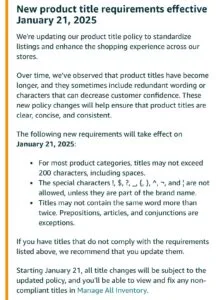
Consequences of non-optimized titles
How poor Amazon listing titles could hurt your rankings
Titles that fail to meet Amazon’s updated guidelines risk significant drawbacks. Long, cluttered, or irrelevant titles often confuse potential buyers. This reduces engagement and discourages clicks, signaling to Amazon’s algorithm that your product is less desirable. Over time, this can lead to a decline in search rankings, making your product harder to find.
Penalties
Amazon actively penalizes listings with non-compliant titles. Poorly optimized titles may face reduced discoverability, meaning your product appears lower in search results. This lack of visibility directly impacts sales potential, as fewer buyers are likely to encounter and purchase your product. In competitive categories, this can be especially damaging, as other sellers with optimized titles dominate search placements.
Why Amazon’s algorithm favors short, clear, and structured titles
Amazon’s algorithm prioritizes titles that are short, clear, and well-structured. These titles provide better clarity for shoppers and align with Amazon’s focus on creating a seamless browsing experience. Structured titles help buyers understand key product details at a glance, improving click-through rates and conversions. By adhering to these standards, sellers can increase their chances of being rewarded with better rankings and higher visibility.
Mastering Amazon listing titles optimization
Crafting compliant Amazon listing titles requires precision and clarity. Focus on including essential information, such as brand name, product type, and key features, while keeping the title concise. Avoid unnecessary adjectives or redundant phrases. Titles should be easy to read and convey the most critical details about the product at a glance.
New character limits: How short is short enough?
Amazon’s updated guidelines set stricter character limits for titles, often capped at around 80 characters, though this may vary by category or region. The goal is to ensure brevity without sacrificing essential details. Titles exceeding the limit risk being truncated, leading to a poor user experience and lower click-through rates. Adhering to these limits can significantly boost your product’s discoverability.
Avoid these mistakes
Overloading your title with keywords or including irrelevant details can backfire. Amazon’s algorithm penalizes keyword stuffing, which makes titles look spammy and unappealing. For example, instead of “Stylish Modern Office Chair Comfortable Durable Adjustable Swivel Best Ergonomic,” opt for “Ergonomic Office Chair – Adjustable Swivel with Lumbar Support.” Focus on relevance and readability to engage customers and enhance conversions.
Regional Adjustments: Adapting Titles for Global Markets
Selling across different regions means tailoring titles to fit local guidelines and consumer preferences. While a minimalist approach might work in one market, others may require slightly more descriptive titles. For instance, in European markets, compliance with language requirements and specific product identifiers is crucial. Ensure your titles align with regional expectations to maintain visibility globally.
Step-by-Step: How to fix your Amazon listing titles manually
- Audit Your Listings: Start by reviewing your existing product titles against Amazon’s updated guidelines. Identify titles that exceed character limits or include unnecessary keywords.
- Prioritize Key Information: Include only the most relevant details, such as brand, product type, size, color, and any unique features.
- Trim the Excess: Eliminate filler words, promotional phrases, and irrelevant details that don’t add value.
- Test and Iterate: Update your titles and monitor their performance metrics, such as click-through and conversion rates. Adjust as needed based on customer feedback and sales data.
- Seek Assistance from AI Tools: Platforms like Epinium can simplify the process, automating title optimization and ensuring compliance across all your listings.
By mastering these techniques, sellers can create effective, rule-compliant titles that resonate with customers and improve rankings.
The AI solution: Simplifying title optimization
How AI tools save time and ensure compliance
Optimizing Amazon listing titles across a large catalog can be a daunting task. AI-powered tools simplify this process by analyzing your titles against Amazon’s latest guidelines. These tools automatically identify titles that exceed character limits, contain irrelevant details, or fail to meet compliance standards. Instead of manually editing each ASIN, AI tools streamline the process, allowing sellers to update titles efficiently while maintaining accuracy.
Benefits of automation for large catalogs and multiple ASINs
Managing hundreds or thousands of ASINs manually is time-consuming and prone to error. Automation tools offer scalability, enabling sellers to optimize multiple titles simultaneously. Key benefits include:
-
Consistency: Ensures all titles across your catalog follow Amazon’s guidelines.
-
Efficiency: Saves hours of manual work by automating repetitive tasks.
-
Real-Time Adjustments: Quickly respond to changes in Amazon’s policies or customer preferences. With AI, even the largest catalogs can be updated in minutes, minimizing downtime and improving overall compliance.
Why Epinium is your partner in tackling Amazon’s title rules
Epinium goes beyond basic automation by offering a comprehensive solution tailored to Amazon sellers. Its AI-driven platform analyzes each product title, provides actionable recommendations, and ensures compliance with Amazon’s rules. Key features include:
-
Custom Recommendations: Tailored suggestions for each ASIN based on your category and region.
-
Real-Time Monitoring: Tracks title performance and highlights areas for improvement.
-
Ease of Use: Intuitive dashboards make it easy to manage large catalogs without technical expertise.
With Epinium, sellers can adapt to Amazon’s evolving requirements effortlessly. Whether you’re optimizing a few listings or a massive catalog, Epinium ensures your titles are compliant, concise, and conversion-ready.
Why this change matters for your business
Adapting to stay competitive in the new Amazon landscape
Amazon’s updated rules for listing titles are more than a simple policy shift; they represent a pivotal change in how sellers compete. With these new guidelines, concise and relevant titles are no longer optional but essential for success. Adapting ensures your products remain discoverable in an increasingly competitive marketplace. Sellers who embrace these changes can leverage them as a competitive advantage to attract buyers and outperform rivals who may lag in compliance.
Leveraging optimized titles to increase sales and visibility
A well-optimized title is one of the most impactful elements in improving your product’s search ranking and click-through rate. Titles that follow Amazon’s rules are rewarded with better visibility in search results, ultimately driving more traffic to your listings. Additionally, clear and structured titles resonate with buyers, making them more likely to convert. This small adjustment can lead to significant gains in both organic and paid performance, helping sellers maximize their return on investment.
Why ignoring this update could cost you dearly
Failing to comply with Amazon’s new title requirements can result in immediate and long-term consequences. Non-compliant listings risk reduced visibility as Amazon’s algorithm prioritizes titles that meet its standards. This drop in discoverability translates directly into fewer sales opportunities, which can quickly snowball into lost revenue. Moreover, persistent non-compliance may even lead to warnings or removal of listings. Ignoring these changes isn’t just risky—it’s a direct threat to your business’s bottom line. Adapt now to safeguard your competitive edge and ensure continued growth on Amazon.
FAQ: Amazon’s New Listing Title Rules
When did Amazon’s new title guidelines take effect?
Amazon rolled out the new product title guidelines on January 21, 2025, driven by the COSMO algorithm update, which emphasizes natural language understanding and context over keyword stuffing.
What is the recommended character limit for Amazon listing titles now?
Amazon recommends titles under 200 characters overall, though updated guidelines often cap titles around 80 characters depending on category or region — titles exceeding the limit risk being truncated.
What happens if my title doesn’t comply with the new rules?
Non-compliant titles can face lower search rankings, suppressed listings in severe cases, and reduced conversions because cluttered or unclear titles confuse shoppers and get deprioritized by Amazon’s algorithm.
What are the most common title mistakes to avoid?
Keyword stuffing, excessive promotional language, unnecessary symbols, and improper capitalization. For example, “Stylish Modern Office Chair Comfortable Durable Adjustable Swivel Best Ergonomic” should become “Ergonomic Office Chair – Adjustable Swivel with Lumbar Support.”
How can I fix my titles across a large catalog efficiently?
Audit your listings against the new guidelines, prioritize essential information (brand, product type, size, color, key features), trim filler words, and use AI tools like Epinium to automate compliance checks and title optimization across hundreds or thousands of ASINs at once.