
AI retail media search ads: How retailers adapt to AI chatbots
AI chatbots are disrupting AI retail media search ads by diverting shopper traffic. Explore the $38B market impact & retailer responses.
 Carlos Martínez Barriga 5 min read
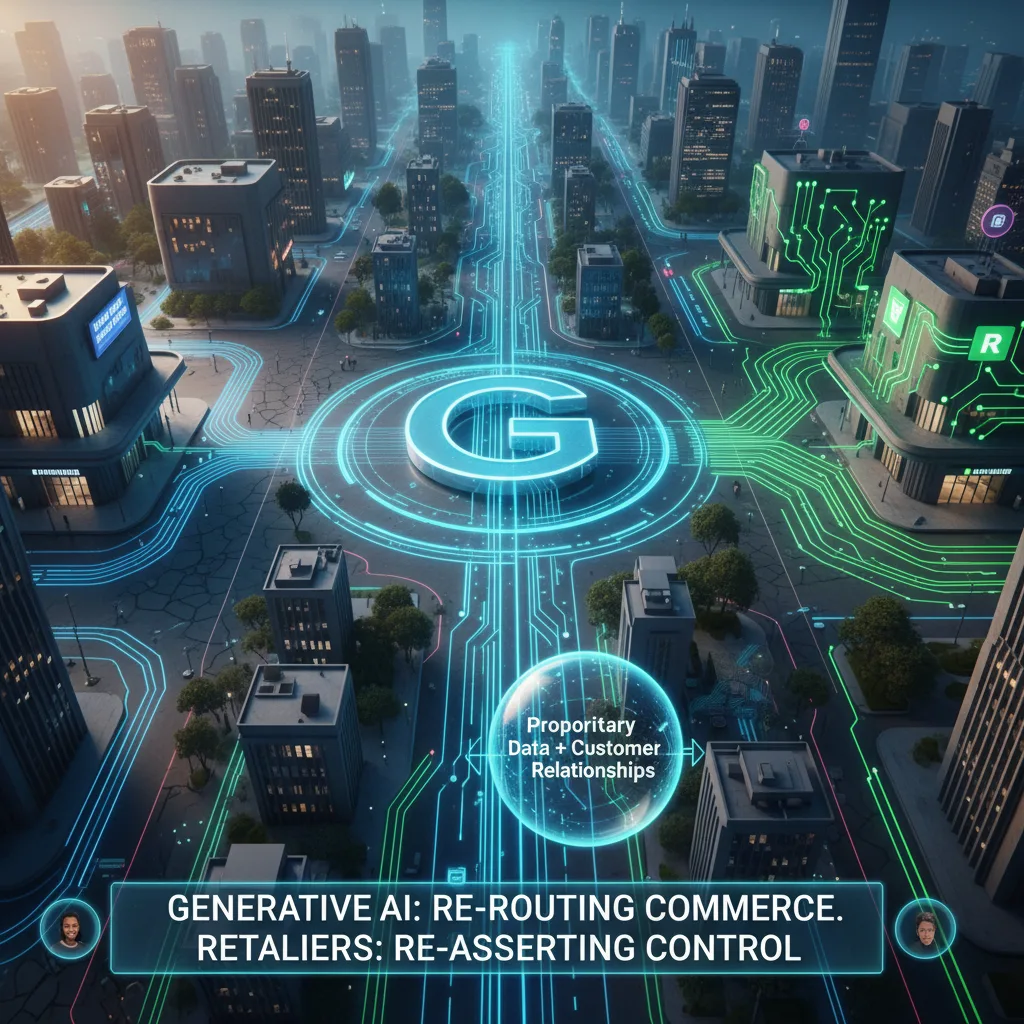
Executive Summary:
- The rapid advancements in large language models (LLMs) and AI chatbots, such as ChatGPT and Google AI mode, are poised to significantly disrupt the traditional AI retail media search ads market by redirecting shopper traffic away from retailer sites.
- This technological shift directly threatens an estimated $38 billion U.S. retail media search ad spend, which, according to eMarketer, constitutes approximately 60% of the total retail media advertising budget.
- Gartner projects a substantial 25% decrease in traditional search engine volume by 2026 due to the increasing adoption of AI chatbots, indicating a parallel potential decline in retailer website traffic crucial for monetizing retail media networks.
- Despite the emergence of new platforms for AI retail media search ads, including ad products from OpenAI, advertisers like Diageo and Procter & Gamble remain committed to established retail media networks, citing concerns over brand safety, high costs, and insufficient data transparency in nascent AI ad offerings.
- The inherent advantage of retail media networks lies in their closed-loop attribution and end-to-end measurement capabilities, leveraging proprietary transactional data—a critical asset that external LLMs currently lack to fully compete in the purchase funnel.
Table of contents
The advent of generative AI is dramatically reshaping the digital commerce landscape, casting a long shadow over the future of traditional retail media. As AI chatbots integrate shopping functionalities and roll out their own ad products, the established dominance of retailer-owned platforms in the realm of AI retail media search ads faces an unprecedented challenge. This shift, as highlighted by a recent Digiday report, could fundamentally alter how brands allocate their significant ad budgets.
Analysis
The core of this disruption stems from a fundamental change in consumer behavior. Shoppers are increasingly turning to conversational AI interfaces for product discovery and research, circumventing direct navigation to retailer websites. This trend is not speculative; Gartner predicts a 25% drop in traditional search engine volume by 2026, primarily driven by the ascendancy of AI chatbots and virtual agents. For the retail sector, where AI retail media search ads represented nearly $38 billion in U.S. spend in 2025 and comprise roughly 60% of total retail media expenditure, according to eMarketer, this diversion of traffic is a critical threat.
Industry experts, including Rita Steinberg, VP of Media at FUSE Create, acknowledge this challenge, stating, ‘It’s a threat, but I don’t think it’s a threat to extinction. It’s a threat to how retail media networks operate as they are. They’re going to have to evolve.’ The concern is palpable among platforms like Walmart, Target, and Amazon, whose retail media networks (RMNs) depend heavily on proprietary site traffic for ad monetization. If a consumer searches for cookware on ChatGPT and completes a purchase via its ‘Instant Checkout’ feature, rather than visiting a specific retailer’s site, the RMN loses a valuable ad impression and potential conversion.
This scenario highlights a direct impact on the revenue streams of RMNs. Publishers have already experienced similar effects, with LLMs causing a reduction in referral web traffic and lower click-through rates. In response, some have implemented bot-blocking measures or secured content licensing deals, indicating the broader industry’s struggle to adapt. Yet, despite the growing influence of AI chatbots, advertisers like Diageo and Procter & Gamble are not yet redirecting their budgets from established retail media channels to emerging AI ad formats. As Ross Walker, Acadia’s Director of Retail Media, notes, ‘Of all the brands that I’m working with, no one is taking money away from retail media to put into AI ads.‘
Why it matters
The long-term impact on AI retail media search ads hinges on several factors. While AI chatbots from companies like OpenAI (ChatGPT), Microsoft (Copilot), and Google (Google AI mode) are beginning to roll out sponsored ad features, they currently lack the comprehensive data and measurement capabilities that define successful retail media. Marketers express valid concerns regarding high costs, brand safety, and limited data transparency within these new AI advertising environments. Crucially, external LLMs do not inherently own the final point of sale or possess the rich transactional data that retailers do. This gives retailers a significant competitive advantage.
Retailers are not standing idly by. Giants like Amazon with Rufus and Walmart with Sparky are developing their own generative AI-powered chatbots. Furthermore, strategic partnerships are emerging, such as Walmart’s collaborations with Google Gemini and OpenAI’s ChatGPT, and Target’s partnership with OpenAI for specialized in-app shopping experiences. These alliances demonstrate retailers’ intent to integrate AI into their existing ecosystems, thereby retaining control over the customer journey and crucial data. As Preston Larson, CEO of Modifly and Chief Media Officer of Court Avenue, emphasizes, ‘Walmart controls that ecosystem, and they’re the ones that can tell where their dollar is going and is it paying it back for brands. And that’s where I see the power.’ The ability of RMNs to provide closed-loop attribution and end-to-end measurement remains a formidable barrier for external LLMs aiming to capture a significant share of the evolving AI retail media search ads market. Retailers, by leveraging their unique data insights and direct customer relationships, are well-positioned to evolve their offerings and maintain influence over brand spend.
FAQ: AI Chatbots and Retail Media Search Ads
How much US retail media search ad spend is at risk from AI chatbots?
eMarketer estimates that retail media search ads represented nearly $38 billion in US spend in 2025, or roughly 60% of total retail media advertising budget. That entire spend category is exposed as Gartner projects a 25% drop in traditional search engine volume by 2026, driven by growing use of AI chatbots for product discovery.
Are advertisers already shifting budgets from retail media to AI ad platforms?
No, not yet. Despite the emergence of ad products from OpenAI and other AI platforms, advertisers like Diageo and Procter & Gamble remain committed to established retail media networks. As Acadia’s Ross Walker put it, none of the brands he works with are pulling money away from retail media to put into AI ads, largely due to concerns over brand safety, cost, and data transparency.
What advantage do retail media networks have over AI chatbots like ChatGPT?
Retail media networks control closed-loop attribution and end-to-end measurement built on proprietary transactional data—something external LLMs currently lack. Retailers own the final point of sale, which gives them a data and measurement advantage that AI chatbots have not yet been able to replicate.
How are retailers like Amazon and Walmart responding to the AI chatbot shift?
Rather than ceding ground, retailers are building their own generative AI shopping assistants, such as Amazon’s Rufus and Walmart’s Sparky, and forming direct partnerships with AI providers, including Walmart’s collaborations with Google Gemini and OpenAI’s ChatGPT and Target’s partnership with OpenAI. This lets them integrate AI into their existing ecosystems while retaining control over the customer journey and data.